
Fintech API authorisation assessment
Anonymised pattern: API-heavy financial product with customer, partner and internal support roles — money-adjacent and PII-bearing endpoints in scope.
At a glance
-
SectorFinTech / payments-adjacent
-
SurfacesCustomer, partner & support APIs
-
Duration classAPI-focused assessment
-
RetestPriority authz retest
Context
The security objective was to validate whether privilege boundaries held across customer, partner and internal support roles on REST APIs — especially endpoints that touched balances, payouts, KYC artefacts or account PII. The organisation wanted manual validation before expanding partner integrations. Staging used synthetic data; production credentials were out of scope.
Buyers in this pattern often arrive via India commercial searches. Useful companions: VAPT services in India and penetration testing company in India.
Engagement shape
API-led assessment with documented OpenAPI where available, three role families, and explicit inclusions for payout and KYC-adjacent routes. Web UI was secondary — exercised mainly where it revealed hidden API clients. Retest covered priority authorisation defects only.
Approach
Read the steps as text
-
Step 1
Discover
Inventory money-adjacent and PII-bearing API surfaces and role families.
-
Step 2
Validate
Object-level and function-level authorisation tests across roles.
-
Step 3
Prove
Demonstrate privilege boundary failures with controlled evidence.
-
Step 4
Remediate
Align API checks with role matrix; tighten support/partner paths.
-
Step 5
Retest
Retest priority authz classes after engineering fixes.
Finding classes (illustrative)
Support-role endpoints returning excess PII; partner tokens accepted on customer-only mutations; state transitions that skipped an approval gate when called out of order; list endpoints that filtered in the client but not on the server. Impact was described in product terms (who could move value or read regulated data) rather than scanner severity alone.
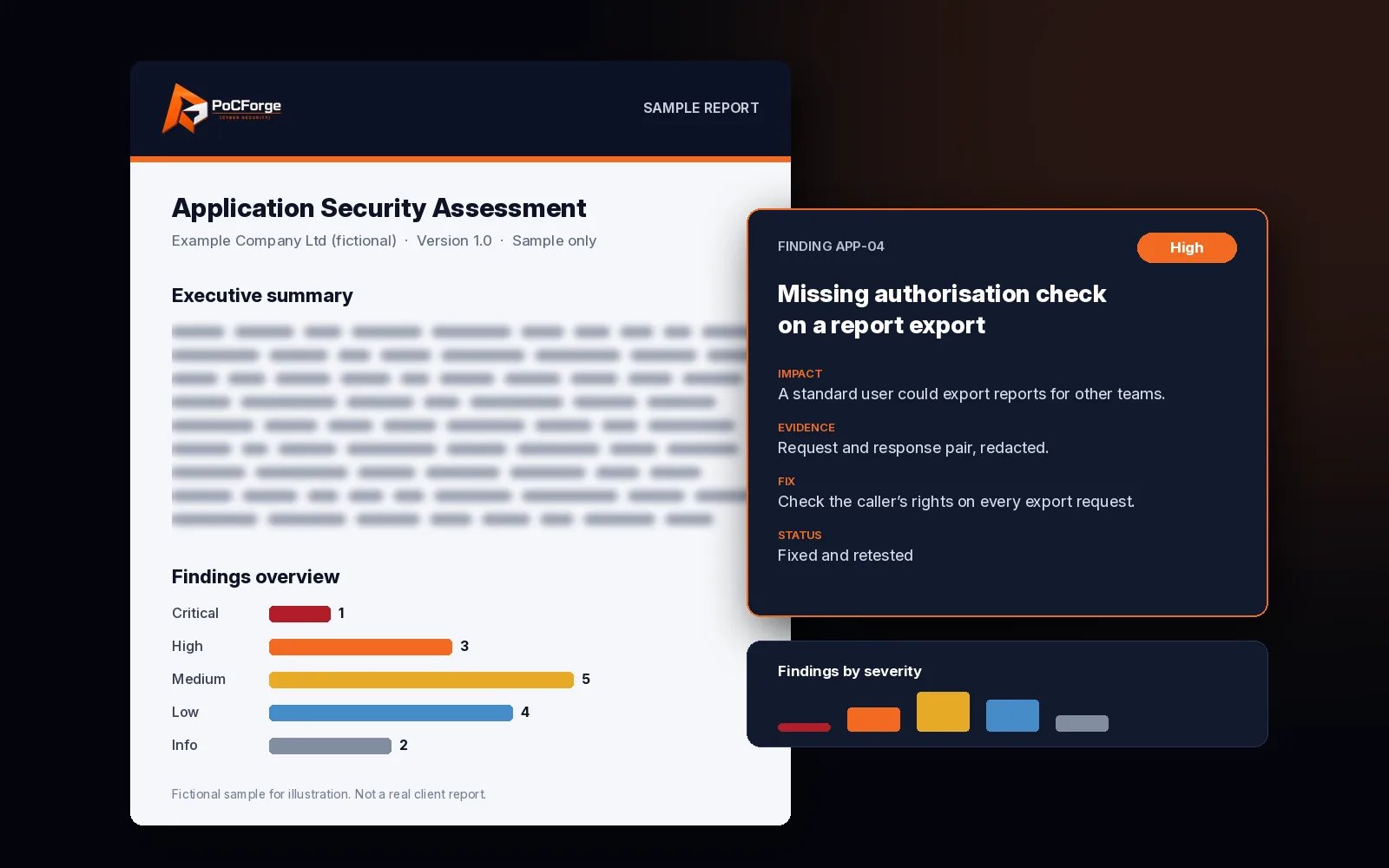
Outcomes and remediation pattern
The team introduced stricter server-side policy checks per role, reduced response payloads for support tooling, and added regression tests around payout state machines. Partner OAuth scopes were narrowed. Retest verified the priority authorisation fixes. Reporting included an executive summary suitable for internal risk committees.
If your API surface is the risk centre, start via contact, compare quotes with the cost guide, and draft scope with the RFQ checklist.
Lessons for buyers
- Provide role matrices and sample tokens early — authorisation testing quality depends on them.
- Separate “support can view” from “support can mutate money” in acceptance criteria.
- Do not confuse CERT-In empanelment with API testing depth; read the CERT-In guide when procurement language is unclear.
Why this pattern shows up before partner launches
Partner APIs multiply trust boundaries. A role that is “read-only” in a slide deck is often “write-capable” in an overlooked admin route. India-market fintech and payments-adjacent teams frequently need this assessment shape before a bank or enterprise partner onboarding. Use VAPT services in India for multi-surface programmes, and keep CERT-In questions clear via the empanelment guide when RFPs mix regulatory language with product-security needs.
What we handed back
The written report separated customer-facing risk from engineering tasks: which role could reach which object class, which state machine skipped a control, and which fixes were verified on retest. Stakeholders who need India commercial framing can continue from VAPT services in India, the VAPT India hub, and the cost guide.
