Most API findings live behind the gateway: broken object-level authorisation, mass assignment, business-logic abuse. CVE-2026-5430 sits one layer up: the component that decides who you are accepts a token it cannot verify. PoCForge (Cyber Security) treats that as a different problem from our BOLA and authorisation-chain research. This defender’s note is for CTOs, CISOs and platform owners running WSO2 or any comparable API management layer. It contains no exploit; every date, version and quotation comes from a public source listed at the end.
1. What WSO2 and the researchers actually said
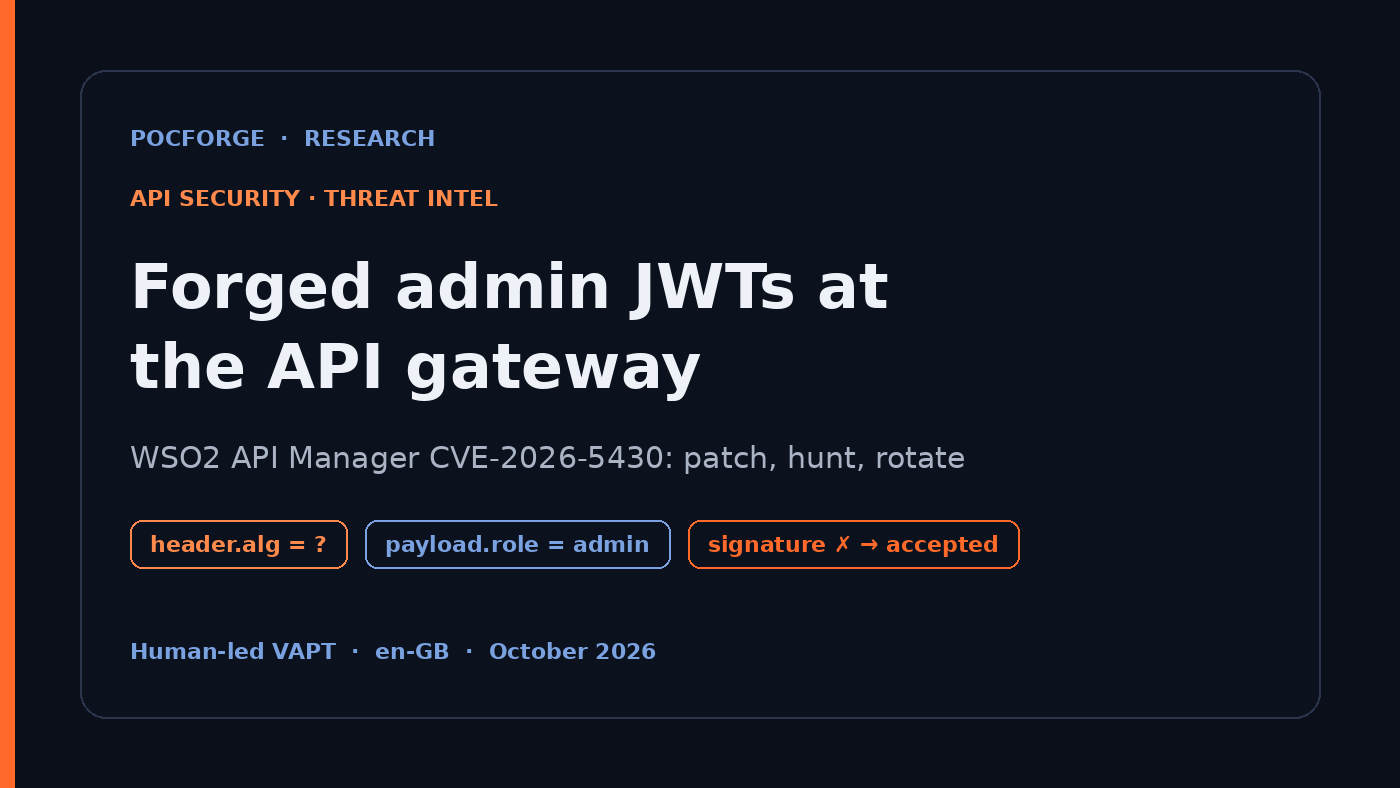
WSO2’s advisory is short. Its description reads: “JWT authentication can be bypassed when a token is signed using an unsupported algorithm, allowing unauthorized access.” The stated impact is unauthorised access, “including potential compromise of administrative accounts and full account takeover.” WSO2 scores it CVSS 10.0 (AV:N/AC:L/PR:N/UI:N/S:C/C:H/I:H/A:H) and adjusts it to 9.8 for single-tenant deployments, where the impact stays inside one security authority boundary. In other words, the multi-tenant case is explicitly the worst case. The issue was reported by the Hacktron Team.
Greenbone’s 30 September analysis describes the root cause as flawed exception handling: when validation of a token with an unsupported algorithm fails, the error is logged but no failed-authentication state is set, so the request proceeds. That is a fail-open path (CWE-347, improper verification of a cryptographic signature). Greenbone also reported that a technical analysis with proof-of-concept code is now public, whereas earlier write-ups said none was available. Either way, watchTowr told SecurityWeek it reproduced the bug from the vendor’s patch, so the lack of a public exploit was never much protection.
| Date (2026) | Event | Source |
|---|---|---|
| 3 May | WSO2 publishes advisory WSO2-2026-5328 with fixed update levels and public pull requests | WSO2 |
| Early August | CVE record for CVE-2026-5430 published | SecurityWeek, Greenbone |
| 13 September | watchTowr honeypot captures a forged JWT with administrator privileges | The Hacker News, SecurityWeek |
| 16 September | Exploitation attempts publicly reported | The Hacker News, SecurityWeek |
| 24 September | Added to CISA KEV; federal due date 27 September; forensic triage flagged | CISA |
| 30 September | Greenbone reports public technical analysis and PoC | Greenbone |
One detail is easy to miss: watchTowr said the observed attacker aimed the forged token at the wrong product, and when researchers replayed it against the real one, it worked. The honeypot was lucky; real deployments will not be.
4.6.0 → update level 21 or higher
Check every gateway and key manager node, not only the console you log in to.
4.5.0 → update level 57 or higher
Record the update level per node in the finding.
4.4.0 → update level 72 or higher
Anything below U72 is in range.
4.3.0 → update level 108 or higher
Anything below U108 is in range.
4.2.0 → update level 197 or higher
Anything below U197 is in range.
4.1.0 → update level 257 or higher
Releases older than 4.1.0 are not listed; an unsupported release is its own finding, not “safe”.
4.6.0 → U22 · 4.5.0 → U58
Control-plane levels differ by one from API Manager on the same line.
4.6.0 → U21 · 4.5.0 → U56
Patch it with the gateways, not after them.
4.6.0 → U21 · 4.5.0 → U57
A patched control plane with an unpatched edge gateway is still exposed.
Apply the public fixes or upgrade
WSO2 points to carbon-apimgt PR 13752 and product-apim PR 14167, or an upgrade. Verify the fix is in the build you deploy.
Update levels from WSO2 advisory WSO2-2026-5328. Include standby, DR and non-production gateways that share keys with production.
2. Why a gateway bypass is not “just another critical”
An API management platform is a concentration point. Greenbone notes that WSO2’s Admin and Developer Portals manage API keys and credentials while the Key Manager handles authentication, authorisation and tokens. watchTowr told The Hacker News that a forged token is suspected to give access to every API back-end endpoint and its credentials, plus the consumer keys and secrets of every registered application. It also described the gateway, which by design intercepts requests on their way to internal systems, as “lateral movement-as-a-service”.
Three consequences follow for buyers:
- Patching closes the door, not the leak. Consumer secrets and back-end credentials that were readable while the system was vulnerable keep working after the update. If a deployment was internet-reachable and unpatched at any point after 3 May, rotation is part of remediation, not an optional extra.
- Multi-tenancy multiplies impact. WSO2’s own scoring treats multi-tenant deployments as crossing a security authority boundary. SaaS platforms, banks and telecoms that run several business units or customers off one installation should assume cross-tenant exposure until logs say otherwise. Our SaaS tenant isolation case study covers why that boundary deserves its own tests.
- The gateway sees traffic. An attacker with administrative control can change routing, policies and mediation, so integrity of API definitions matters as much as confidentiality of keys.
SecurityWeek reports nearly 1,000 WSO2 enterprise customers in banking, government, telecoms and logistics, with thousands more via open source, OEMs and partners. Some organisations run WSO2 inside a vendor product without knowing it, so inventory comes before patching.
3. Triage from the advisory, not the KEV headline
At the time of writing, CISA’s KEV entry for CVE-2026-5430 is titled “WSO2 Multiple Products Path Traversal Vulnerability” and describes a path traversal that could allow unrestricted file upload and remote code execution. The vendor advisory describes a JWT algorithm bypass and says nothing about file upload. The KEV entry’s own weakness field, CWE-347, agrees with the vendor, and its remediation link points at the correct WSO2 advisory. Threat Frontier highlighted the same mismatch.
The practical risk is misdirected hunting. A team working only from the KEV feed may search for web shells and traversal strings and miss what this bug actually produces: administrator sessions nobody can account for, edited API definitions and quietly used consumer secrets. The CVE ID, the affected product list and the due date are useful. Hunt from the vendor description.
4. The wider pattern: JWT validation that fails open
WSO2 is the timely example, but the defect class is old. RFC 8725, the IETF’s JSON Web Token Best Current Practices, warns that the alg header has enabled attacks such as switching to none and RSA-to-HMAC confusion. Its remedies are blunt: libraries must let the caller specify a supported set of algorithms and must not use any other (section 3.1), and the entire JWT must be rejected if any cryptographic operation fails to validate (section 3.3). CVE-2026-5430 is what happens when the second rule is broken in an exception handler.
The same failure can exist in custom gateway plugins, service-mesh filters, Lambda authorisers and in-house middleware. That is why PoCForge tests the token-validation layer directly in API security testing engagements rather than assuming the platform is correct. The matrix below is the negative-test set we run, in agreed non-production environments, with tokens that carry no real privileges.
Does an unknown algorithm get a 401?
Present a well-formed token naming an algorithm outside the configured set. Expected: rejection and a logged authentication failure. Anything else is critical.
Unsigned tokens
Unsigned tokens must be refused on every protected route, including admin and portal APIs.
One key, one algorithm
A public verification key must never be accepted as an HMAC secret.
Header-driven key lookup
Treat kid, jku and x5u as attacker input: test for injection and unapproved outbound fetches.
Right issuer, right audience
A valid token from staging, another tenant or another client must not work here.
What happens when validation throws?
Malformed or unexpected input must end in rejection. Look for exceptions that are logged and then ignored, the root cause Greenbone describes.
Run only with written authorisation, against non-production where possible, using test identities. Never forge administrator tokens against production to “prove” a version finding.
5. Assume-breach checklist for exposed deployments
If a WSO2 component was reachable from the internet while below the fixed level, treat it as potentially compromised until reviewed. Beazley Security suggests starting with the HTTP access logs under repository/logs/http_access_*.log and looking for successful (HTTP 200) responses to /api/am/admin/, /api/am/publisher/ and /api/am/devportal/ that do not line up with legitimate logins. The rest of the list follows from what a forged administrator could reach.
0 checked
Ticks stay in this browser only. They are not sent anywhere.
6. What CTOs and CISOs should ask for
For regulated Indian buyers, timing matters. Exchange circulars implementing SEBI’s Cybersecurity and Cyber Resilience Framework (CSCRF), such as MSEI circular MSE/INSP/17876/2025, set 30 November 2026 as the date for many SEBI-regulated trading members (outside the QSB and protected-system categories) to submit action-taken and revalidation reports on their FY 2025–26 VAPT. An exploited gateway bypass discovered now belongs in that closure evidence, not in next year’s scope. If you are unsure which auditor requirements apply, read our guide on when CERT-In empanelment matters.
A useful finding names the host, product and update level, states how long it was reachable, records which credentials were rotated and confirms a retest by version and negative token tests. A weak finding pastes the advisory. Put the gateway and key manager explicitly in scope next time; our VAPT RFQ guide helps.
Engagement scope prompt (copy for RFQs)
Include: (1) inventory of API management components and versions, including OEM-embedded ones; (2) negative token-validation tests against gateway, admin and portal APIs in a non-production environment; (3) tenant-boundary checks for multi-tenant deployments; (4) review of credential rotation and log evidence after exposure; (5) retest. Exclude: forging privileged tokens against production.
7. Related PoCForge services and research
- API security testing · Web application penetration testing
- External infrastructure penetration testing for internet-facing gateways and portals
- Research: API authorisation chains, BOLA, business logic
- Case study: Fintech API authorisation
Frequently asked questions
Which WSO2 products does CVE-2026-5430 affect?
API Manager 4.1.0 to 4.6.0, and API Control Plane, Traffic Manager and Universal Gateway 4.5.0 and 4.6.0. Fixed update levels are in advisory WSO2-2026-5328; open-source users apply the public pull requests or upgrade.
Is it actually being exploited?
Yes. watchTowr reported a forged administrator JWT on 13 September 2026; CISA added the CVE to KEV on 24 September 2026.
We have patched. Are we finished?
Not if the system was exposed while vulnerable. Public reporting says a forged token can reach consumer keys, secrets and back-end credentials, and those keep working after the patch. Review logs, reconcile admin changes and rotate credentials you cannot prove stayed untouched.
Why does the KEV entry mention path traversal?
At the time of writing, the KEV name and description do not match the vendor advisory, which describes a JWT algorithm bypass. The KEV CWE (CWE-347) and the linked advisory are consistent with the vendor. Hunt from the WSO2 description.
We do not use WSO2. Does this matter to us?
The defect class does. Any gateway, authoriser or middleware that validates JWTs can fail open on unexpected algorithms or exceptions. RFC 8725’s algorithm allowlisting and reject-on-any-failure rules are the test standard, and a scoped API assessment should include negative token tests.
Sources (public)
- WSO2 — Security Advisory WSO2-2026-5328 / CVE-2026-5430 (3 May 2026)
- CISA — CISA Adds Two Known Exploited Vulnerabilities to Catalog (24 September 2026) and the KEV catalogue
- The Hacker News — Active Exploitation Attempts Target WSO2 API Manager JWT Bypass With Forged Admin Tokens (16 September 2026)
- SecurityWeek — Enterprises Warned of Attacks Exploiting WSO2 Vulnerability (16 September 2026)
- Greenbone — CVE-2026-5430: Full Account Takeover in WSO2 API Management Products Now Actively Exploited (30 September 2026)
- Beazley Security — Critical Authentication Bypass in WSO2 API Management Products Under Active Exploitation
- Threat Frontier — WSO2 API Manager JWT Bypass Exploited 133 Days After the Fix (2 October 2026)
- IETF — RFC 8725: JSON Web Token Best Current Practices
- MSEI — Circular MSE/INSP/17876/2025, Submission of VAPT Report for FY 2025-26
PoCForge (Cyber Security) publishes offensive-security research to explain attack paths and defensive controls. This article does not describe a named client engagement, does not include exploit code and is not a claim of CERT-In empanelment.