
API security testing in India for SaaS and product teams
Manual API penetration testing focused on authorisation failures, data exposure, authentication weaknesses and workflow abuse — with validated evidence and one remediation retest. Built for Indian product organisations that expose sensitive actions through REST or GraphQL.
-
₹25,000 – ₹60,000Indicative India band, + GST
-
Scope-based quoteConfirmed after a short scope review
-
Retest includedWithin 6 months of the test
-
Remote deliveryFor India-market and international teams
-
Authorisation testing
Object-level and function-level authorisation across users, roles and tenants — including BOLA-style access failures.
-
Authentication & tokens
Auth flows, token handling, session controls and privilege boundaries that matter in real SaaS APIs.
-
Business logic & abuse
Workflow manipulation, rate-limit gaps, excessive data exposure and chained attack paths across endpoints.
Why Indian product teams invest in API security testing
Most modern Indian SaaS and fintech products expose value through APIs — not only through a browser UI. Customer portals, partner integrations, mobile backends and admin tooling all share the same API layer. When authorisation is incomplete, a single endpoint can leak another tenant’s data or allow a low-privilege user to perform privileged actions.
PoCForge runs human-led API security testing for organisations that need validated findings, clear evidence and a remediation retest — not a raw scanner export. We work remotely with India-market and international teams, and we publish indicative INR ranges on our penetration testing cost guide.
What API penetration testing covers
Scope is tailored to your endpoints and workflows. Typical coverage includes:
- REST and GraphQL surfaces (and related service APIs in scope)
- Broken object-level authorisation (BOLA / IDOR-style access control)
- Broken function-level authorisation
- Authentication, session and token controls
- Excessive data exposure in responses and error paths
- Mass assignment and parameter pollution patterns
- Rate limiting and abuse controls where they affect security outcomes
- GraphQL schema exposure, resolver authorisation and nested query abuse
- Business-logic and multi-step workflow manipulation
- Injection and input validation on high-value parameters
We prioritise attack paths that change who can see or change data — especially multi-tenant boundaries — over checklist volume.
Indicative India pricing for API security testing
PoCForge’s published API band is typically ₹25,000 – ₹60,000 + GST for focused API scopes, with combined web + API commonly ₹55,000 – ₹1,10,000 + GST when the UI and API share risk. Final quotes follow a short scope review. See the full 2026 bands on the cost guide or build an estimate on the starting prices.
Deliverables
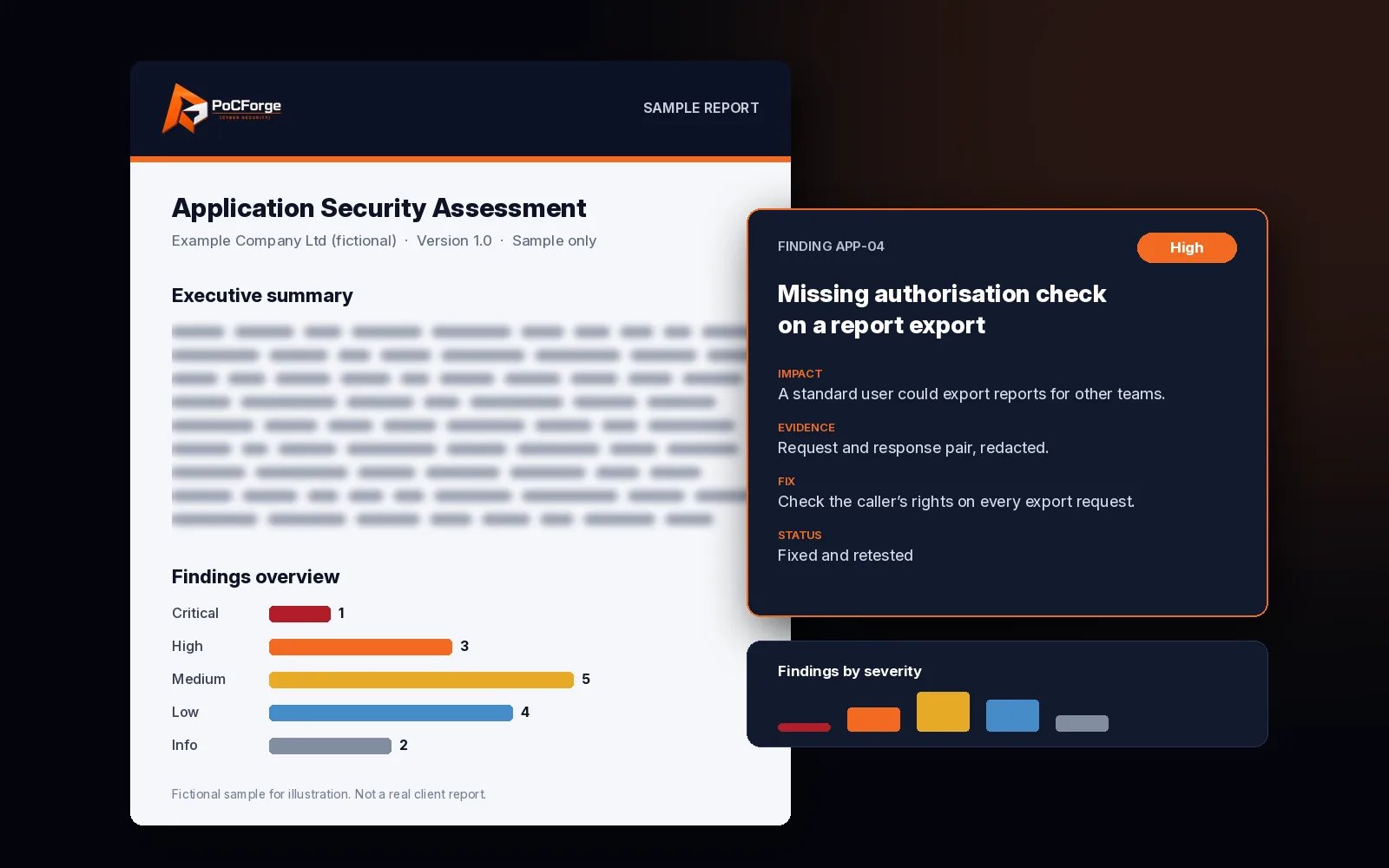
- Executive summary suitable for customer security questionnaires
- Technical findings with affected endpoints, evidence and impact
- Remediation guidance aimed at engineering owners
- Retest notes / closure status for fixed in-scope items
API testing for multi-tenant SaaS
Indian SaaS companies selling to enterprise buyers are routinely asked about tenant isolation. API testing should model realistic authenticated users across tenants and roles, not only unauthenticated probing. PoCForge designs test accounts and objectives around your tenancy model so findings map to product risk language your engineering and security teams can act on.
Related reading: anonymised patterns in our case studies, including API authorisation themes.
When to combine API testing with other surfaces
APIs rarely sit alone. Combine with web application penetration testing when the browser client and API share session and authorisation logic; with mobile testing when apps call the same backends; and with external infrastructure when public edge, gateways or VPN front the API. Start from VAPT services in India if you need a programme view.
What “good” looks like in an API report
Useful findings name the failed control (for example missing object ownership checks), show a reproducible request path, and explain business impact in product terms — which tenants, which data, which privileged action. Low-signal noise should be filtered. If a vendor cannot explain an issue without jargon alone, treat that as a selection signal.
Common API failure patterns we prioritise
Every product is different, but certain failure classes appear repeatedly in SaaS and fintech APIs used by Indian teams:
- Object-level gaps — changing an ID in a path or body returns another user’s or tenant’s record.
- Function-level gaps — a standard user can invoke admin-only operations because the check lives only in the UI.
- Over-broad tokens — long-lived tokens with excess scopes, weak rotation or unclear revocation.
- Verbose errors — stack traces or internal identifiers that speed up further attacks.
- Workflow skips — multi-step processes that can be reordered or replayed to bypass business rules.
Findings are those we can demonstrate under the agreed rules of engagement, with enough detail for engineers to reproduce and fix.
Preparing for an API test (buyer checklist)
- List base URLs and environments (staging preferred when production risk is high)
- Describe authentication (session cookies, JWT, OAuth, API keys, mTLS)
- Provide at least two roles per relevant tenant where multi-tenancy matters
- Call out critical workflows (payments-adjacent, admin, export, invite, password reset)
- Note rate limits, WAF rules and change freezes
- Confirm whether GraphQL introspection is expected in the test environment
A one-page brief with this information usually shortens scoping and improves quote accuracy. Start via contact.
API testing vs OWASP API Top 10 checklists
Industry lists such as the OWASP API Security Top 10 are useful vocabulary for buyers and engineers. PoCForge engagements are not a rote checkbox exercise against any single list, but we deliberately cover the risk themes those lists emphasise — especially broken authorisation, data exposure and security misconfiguration — because that is where product impact concentrates. Methodology structure draws on professional testing practice (for example PTES-style phases).
Frequently asked questions
How much does API security testing cost in India?
PoCForge’s indicative API testing range is ₹25,000–₹60,000 + GST depending on endpoint count, authentication complexity and testing depth. Combined web+API programmes are often ₹55,000–₹1,10,000 + GST. Final quotes are scope-based.
Do you test GraphQL APIs?
Yes. GraphQL testing can include schema exposure, authorisation on resolvers, nested query abuse and business-logic issues — within the agreed scope.
Can API testing be combined with web testing?
Yes. Combined web + API assessments are common when the two surfaces share authentication and authorisation.
Do you only run automated API scanners?
No. Tooling helps coverage; reported issues are manually validated with evidence wherever safe and authorised.
How long does an API engagement take?
Small focused API scopes often complete in days to a couple of weeks including reporting. Larger multi-service programmes take longer. Timeline is confirmed during scoping.
Are you CERT-In empanelled?
Do not assume empanelment from marketing pages. If your contract requires CERT-In empanelment, verify the official CERT-In list for the contracting legal entity. See our CERT-In decision guide.
Related PoCForge guides
Need a scope-based estimate?
Share your application, infrastructure or security requirement and PoCForge will help define the right assessment.
