
Wireless penetration testing
A human-led test of the Wi-Fi and wireless segments around your sites: how clients authenticate, whether guest and corporate networks are really separated, and whether someone nearby could reach your internal systems.
- Human-led
- Rogue access points checked
- Retest included
-
Wireless to internalWhere the path inside leads
-
Sized to scopeDates agreed after the scope call
-
Retest includedWithin 6 months, up to 10 issues
-
Walkthrough callEvidence, steps and fixes
Who this is for
A good fit
- Organisations that run corporate Wi-Fi, guest networks or device networks across offices, warehouses, clinics or factories.
Worth knowing
- Useful when you are opening a new site, changing controllers, moving to enterprise authentication, or answering a question from an auditor who wants evidence that wireless is not a quiet path into the domain.
What we test
Authentication and encryption
WPA2-Personal and WPA3-Personal (pre-shared key) set-ups
Details
- WPA2-Personal and WPA3-Personal (pre-shared key) set-ups
- WPA2-Enterprise and WPA3-Enterprise with EAP methods
- RADIUS and certificate validation on enterprise clients
- Shared or reused pre-shared keys across sites
- Legacy protocols still enabled (WEP, WPA, TKIP)
Segmentation and isolation
Guest, visitor and corporate network isolation
Details
- Guest, visitor and corporate network isolation
- Device, IoT and printer networks
- VLAN hopping and misrouted traffic from wireless
- What each SSID can reach on the internal LAN and the internet
- Captive portal bypass and session reuse
Rogue and spoofed access points
Evil-twin and soft-AP exposure for your clients
Details
- Evil-twin and soft-AP exposure for your clients
- Unauthorised access points on the premises
- Client behaviour when a known network name appears nearby
- Probe-request leakage of preferred networks
- Detection by any wireless intrusion system you run
From wireless to internal
Credential capture and reuse against internal services
Details
- Credential capture and reuse against internal services
- Certificate and trust issues that enable man-in-the-middle
- Pivot into the wired LAN or Active Directory
- Links to findings from an internal or assumed-breach test
About this scope
Scope is set by site, network names (SSIDs) and the segments behind them. Testing is done on site, within agreed times and physical boundaries. We follow the wireless and network testing guidance in NIST SP 800-115 and check configurations against common industry practice, including CIS wireless control language where it fits your environment.
What you receive
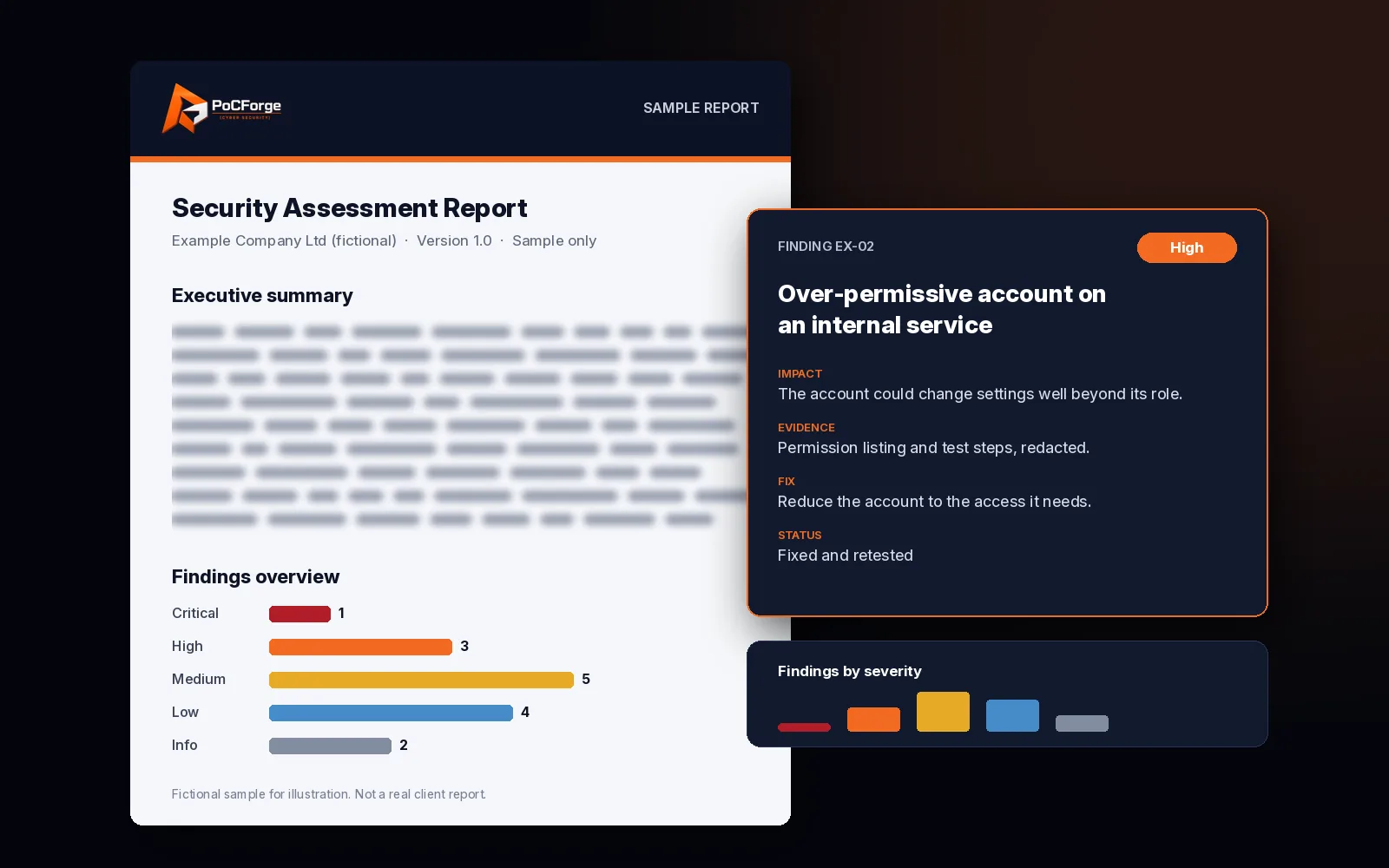
- An executive summary written for non-specialists.
- Technical findings with evidence (captures, screenshots, steps to reproduce).
- Severity based on what a nearby attacker could actually reach.
- Remediation guidance for network and security owners.
More about the report
- A walkthrough call.
- A retest of in-scope fixes that are ready within 6 months of the original test (up to 10 issues), with an updated closure note.
Common findings (examples)
These are patterns we often see. They are not a scorecard for your site.
- A guest network that can reach internal print or file servers.
- A shared pre-shared key reused across every office, never rotated after staff leave.
- Enterprise clients that accept any certificate for the corporate SSID.
- An unauthorised access point plugged into a wall port and bridging into the LAN.
- Device or IoT SSIDs with no isolation and default credentials on the controllers.
What we need from you
- Site addresses, floors and any restricted areas.
- SSID list and a contact who can approve access on the day.
- Whether you want guests, staff or device networks in scope.
- Written agreement on disruptive techniques and out-of-hours windows.
- Optional read-only access to wireless controllers for configuration review.
Typical timeline
Duration depends on the number of sites, floors and SSIDs. A single office with a few networks is often a short engagement; multi-site work with enterprise authentication and a pivot into the LAN takes longer. We agree dates after the scope call.
Standards and method
Testing follows the wireless and network assessment practices described in NIST SP 800-115. Configuration checks draw on common industry control language (including CIS wireless and network controls where they apply to your gear).
On site we combine passive survey, authenticated client testing and, where you allow it, controlled active techniques. Captures stay on encrypted storage and are destroyed or returned according to the engagement agreement.
Scope options
- Single site. One office or warehouse, all SSIDs you name, with or without a pivot into the LAN.
- Multi-site. The same method across several locations, with a combined report and per-site annexes.
- Controller review only. Read-only review of wireless controllers and policies when an on-site survey is not yet approved.
- Combined with internal testing. Wireless findings that lead into the LAN can be handed to an internal network and Active Directory engagement so the path is followed all the way.
What stays out of scope by default
- Staff home routers and personal hotspots.
- Neighbouring networks you do not own.
- Destructive radio jamming.
- Physical break-in to plant rooms or cabinets (unless a separate physical scope is agreed).
Reporting that network owners can use
Each wireless finding names the SSID, the approximate location and the evidence (capture, screenshot or reproduction steps). Severity follows what a nearby attacker could reach — a guest network that opens an internal file share ranks higher than a weak guest portal with nowhere to go. Remediation is written for the team that owns the controllers and for the team that owns the LAN behind them, so the fix does not stall between two owners.
If wireless testing is booked with an internal network engagement, the report cross-links paths that continue past the access point so you are not left with two disconnected PDFs.
Working around live sites
Hospitals, factories and trading floors often cannot accept noisy testing in business hours. We plan quiet survey windows, mark exclusion zones on a floor plan and keep a stop contact on call. If a controller change or a cutover is planned the same week, tell us — we would rather shift days than collide with your change window.
Scope and rules
- Scope call. Sites, floors, SSIDs, permitted times, exclusion zones and whether disruptive techniques (for example deauthentication) are allowed.
- Survey. A walk of what is broadcast in and around each site, including neighbouring and rogue signals.
- Authentication and client testing. Enterprise and personal modes, certificate checks and client behaviour under spoofed networks.
- Segmentation checks. What each network can actually reach, not what the diagram says.
- Controlled pivot. Where agreed, attempts to move from wireless into internal systems, within the written rules.
- Report and retest. Findings with evidence, a walkthrough and a retest of fixes that are ready within 6 months of the original test (up to 10 issues).
Internal AD lateral-movement pattern
Anonymised internal AD / identity engagement pattern: meaningful privilege paths versus scan noise, with remediation and retest framing.
Read the case study →- Human-led
- Rogue access points checked
- Retest included
Related
Frequently asked questions
Does wireless testing need someone on site?
Yes. Wireless signals have to be tested where they are broadcast. Visits are planned with you in advance.
Will testing disconnect users?
Deauthentication and other disruptive techniques are only used if you agree to them in writing, and within set times.
Is wireless included in an internal network test?
No. Wireless is its own scope. It can be booked alongside an internal network and Active Directory test.
Do you test Bluetooth or other radio types?
Corporate Wi-Fi is the default. Other radio technologies can be discussed if they are part of your risk.
Can you cover home or remote-worker Wi-Fi?
Only if those networks are under your control and named in the scope. Home routers belonging to staff are usually out of scope.
Do you need accounts on the Wi-Fi?
For guest networks, often no. For enterprise authentication we need a test account and, where relevant, a test device certificate.
Will the report name exact BSSIDs and floors?
Yes, so your team can find and fix the right access points. Sensitive floor plans stay in the confidential appendix.
How does this help with audits?
The report can support evidence requests that ask whether wireless access is controlled and segmented. It is not a certificate.
Ready to scope this?
Tell us what is in scope and what you want to learn. We reply with a suggested approach.
Request a free scope review →