
Internal AD lateral-movement pattern
Anonymised pattern: enterprise internal assessment where Active Directory and identity edges produce meaningful findings — not a wall of scanner noise.

At a glance
-
SectorEnterprise identity estate
-
SurfacesAD, identity services, internal apps
-
Duration classInternal network / identity window
-
RetestPath & privilege retest
Context / challenge
An enterprise security team needed an internal network and identity review that would separate privilege paths that matter from the usual volume of informational scan output. Leadership wanted evidence suitable for remediation owners and for explaining residual risk — not a 200-page appendix of low-value findings.
Assumed starting access and rules of engagement were explicit. Production-safe techniques and staged proof were preferred. This pattern aligns with our network & Active Directory pentesting service.
Engagement shape
Typical shape: time-boxed internal assessment with clear crown-jewel or tiering objectives, identity-centric methodology, and a triage agreement up front (what “meaningful” means for this estate). Scan tooling may assist discovery; validation and narrative stay human-led.
Kick-off clarifies whether the goal is domain privilege paths, access to sensitive applications, or both — and what must never be touched.
Approach
Read the steps as text
-
Step 1
Discover
Map identity estate, trusts, tiers and sensitive targets under RoE.
-
Step 2
Validate
Confirm which privilege and trust edges are real versus scanner noise.
-
Step 3
Prove
Demonstrate path classes with controlled evidence — no unnecessary disruption.
-
Step 4
Remediate
Prioritise delegation, tiering, credential hygiene and detection gaps.
-
Step 5
Retest
Verify priority paths closed; document residual risk clearly.
Finding classes (illustrative)
Illustrative finding classes: excessive or unintended delegation; privilege paths via misaligned group nesting; legacy authentication or protocol weaknesses still reachable; service account hygiene issues that enlarge blast radius; segmentation gaps between tiers; detection blind spots along likely movement edges.
We frame findings by business impact and exploitability under the agreed start conditions — not by raw plugin counts.
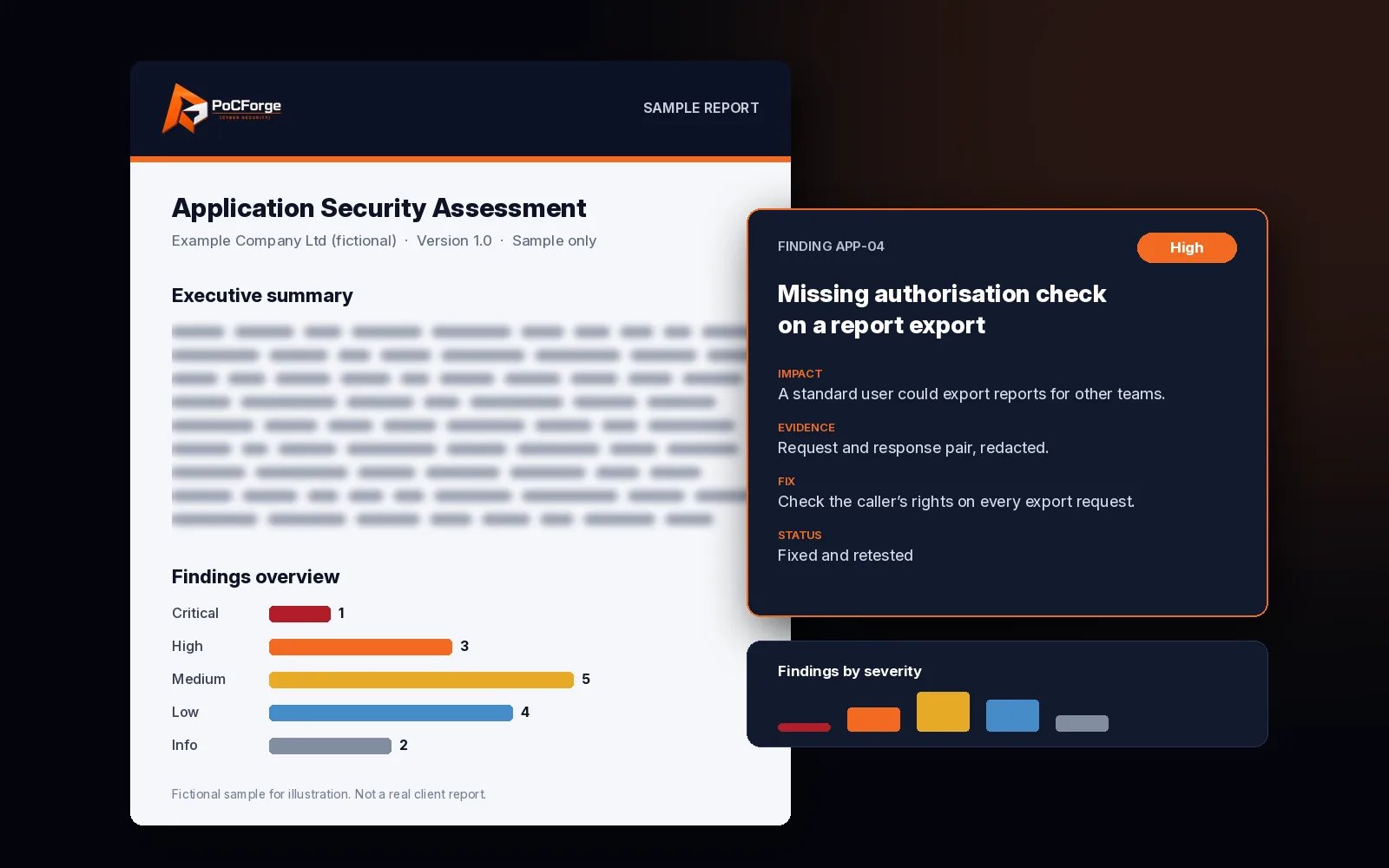
Outcomes and remediation pattern
Typical remediation themes: tighten delegation and privileged group membership, retire or isolate legacy auth where feasible, improve tiering and segmentation, rotate and constrain service credentials, and tune detections for the path classes demonstrated. Retest confirms closure of priority paths.
Exact hostnames, personal names and exploit steps stay out of public write-ups by design.
Lessons for buyers
- Insist on a “meaningful vs noise” triage before the report ships.
- Scope identity and AD explicitly — network-only scans miss the story.
- Ask how findings will be mapped to owners and retest.
- Board narrative should describe path classes, not dump TTPs.
Related patterns & research
Want this engagement shape scoped for you?
Share constraints and success criteria — PoCForge will propose a human-led plan with proof and retest.