
Red team assumed-breach engagement
Anonymised pattern: assumed-breach red team with multi-surface objectives — detection gaps and a board-ready story without a TTP dump.
At a glance
-
SectorEnterprise / multi-surface
-
SurfacesEndpoint, identity, cloud, apps (scoped)
-
Duration classObjective-led red team window
-
RetestDetection & control follow-up
Context / challenge
An enterprise wanted to know what an operator could achieve from an agreed foothold, and whether detections would notice. Objectives spanned identity, endpoint and a scoped application or cloud surface. The buyer needed a narrative leadership could act on — not a dump of tool output or a catalogue of every technique used.
Rules of engagement, out-of-bounds systems and communication paths were fixed before start. This sits under our red teaming / adversarial simulation offering within security assessments.
Engagement shape
Typical shape: assumed-breach start, time-boxed objectives, dual reporting track (technical for defenders, executive for decision-makers). Purple-team moments may be scheduled if the buyer wants detection validation during the window rather than only at the end.
Success is objective progress plus clear detection coverage notes, not just “we got domain admin”.
Approach
Read the steps as text
-
Step 1
Discover
Confirm foothold assumptions, objectives and out-of-bounds with the buyer.
-
Step 2
Validate
Pursue objectives across agreed surfaces; note where controls stop progress.
-
Step 3
Prove
Capture evidence for objective outcomes and detection gaps — no unnecessary blast radius.
-
Step 4
Remediate
Translate into detection engineering and hardening priorities.
-
Step 5
Retest
Optional replay of agreed classes to validate new detections.
Finding classes (illustrative)
Illustrative outcome classes: objectives reached or blocked; detection gaps along the path; control strengths that stopped progression; process or handoff delays that mattered more than any single technical flaw. We describe classes of technique at a level useful for defence — we do not publish step-by-step exploit payloads or a TTP dump on marketing pages.
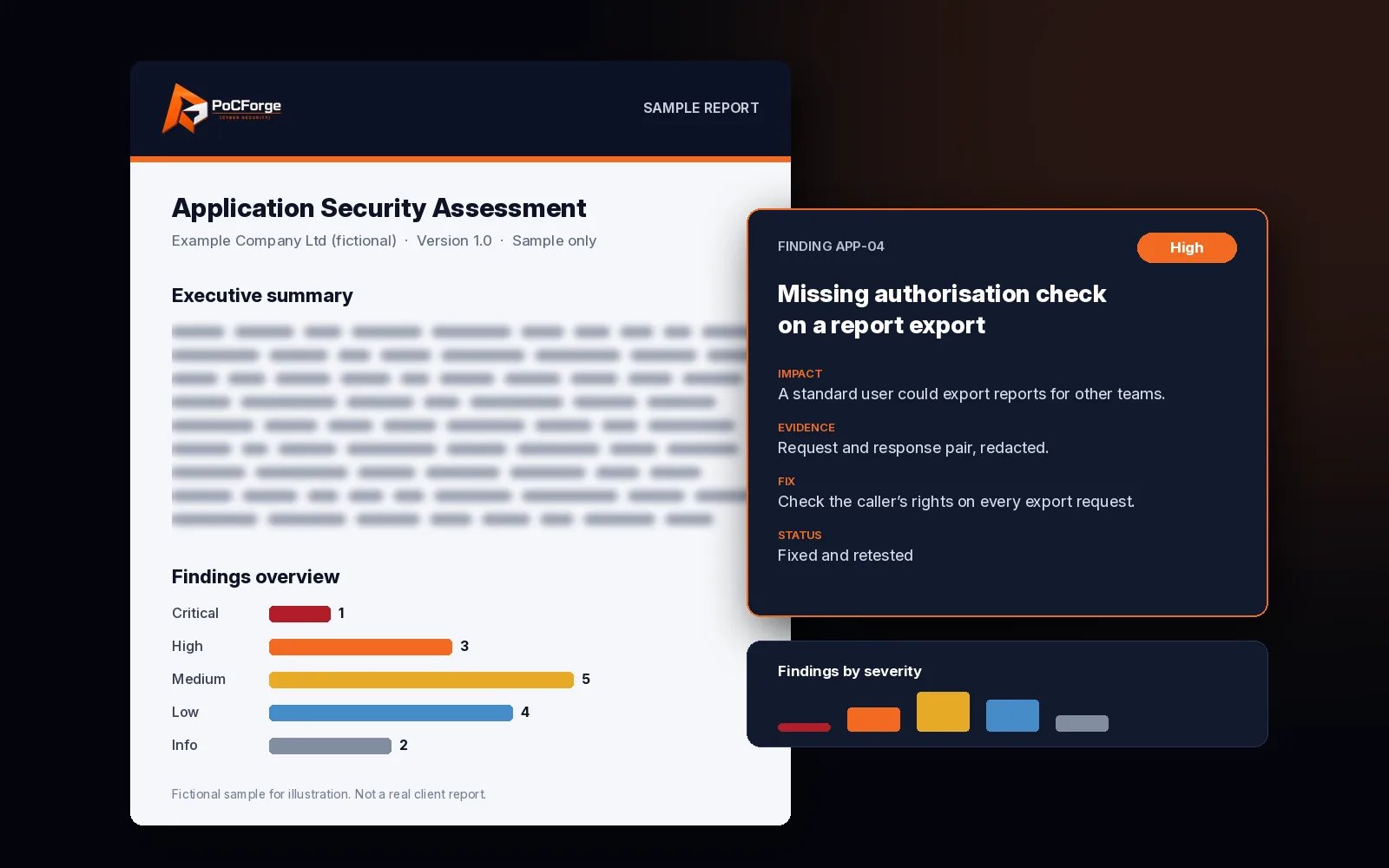
Outcomes and remediation pattern
Defenders usually leave with prioritised detection engineering work, identity and endpoint hardening themes, and a board summary that explains residual risk in plain terms. A follow-up window can validate that agreed detections now fire on the replayed classes.
Lessons for buyers
- Write objectives and out-of-bounds before kick-off.
- Demand an executive narrative and a defender narrative — one report rarely serves both.
- Measure detection, not only “did they get in.”
Related patterns & research
Related
Want this engagement shape scoped for you?
Share constraints and success criteria — PoCForge will propose a human-led plan with proof and retest.