SSRF in web applications: how it is found, what it leads to, and how to prevent it
Server-side request forgery turns an application's own "fetch this URL" features into a route past the firewall. This is what it is, where it appears, what it leads to, and the controls that stop it.
In SSRF the server, not the user, makes the request, from inside the trust boundary.
SSRF turns an application’s own “fetch this URL” feature into a way to make the server reach places an attacker never could. These are our working notes: what it is, where we find it, and what it buys. No working payloads.
Weakness
CWE-918
Server-side request forgery
OWASP Top 10
A10:2021
Added on community survey
Who sends it
The server
From inside the network
Top prize
Cloud creds
Via metadata service
What it is, in one line
MITRE: a server “retrieves the contents of this URL, but it does not sufficiently ensure that the request is being sent to the expected destination.” We are not attacking the app — we are borrowing its position on the network.
The user's request becomes the server's request. One path goes where intended; the other crosses the trust boundary.
Where we go looking first
Link previews
“Unfurling” of pasted links
Webhooks
Callback & notification URLs
Generators
PDF / report / screenshot tools
Import “from URL”
Image, document or data import
Integrations
User-typed server addresses
Parsers (XXE)
XML external entities become SSRF
None of these announce themselves as risky, so we enumerate them methodically. OWASP also notes the server-side request can use schemes beyond plain HTTP.
What a confirmed SSRF buys
01 · Proxy
Reach what we can’t
The app makes requests for us. CWE-918 calls it “bypass protection mechanism” — the request looks trusted, so it slips past firewalls.
02 · Credentials
Cloud metadata
OWASP: SSRF is often used to steal tokens from metadata services. AWS serves IAM role credentials on a link-local address only the instance can reach.
03 · Pivot
Map & move
Map internal networks, expose data, abuse internal services. A proven SSRF is a starting position, not the finish.
We grade severity by what comes back. Blind SSRF (only a yes/no) is reported differently from one that returns the full internal response — which is why raw responses should never reach the client.
The request flow
Step through three views of the same feature: intended use, an abused request, and the same request against a protected design. Hover or tap each component to see its role.
An allowlist is a gate: approved destinations pass, everything else stops before the server makes a request.
How we test it in an engagement
1
Enumerate every fetch feature
Including admin-only settings and server-side file parsing. One missed field is usually the one that matters.
2
Confirm the primitive
Point it at an endpoint we control; watch whether the server calls out, and from what source address.
3
Test the controls
Allowlist enforcement, schemes and ports, and whether a redirect to a disallowed destination is refused or followed.
4
Test resolution
Does the control apply to the address actually connected to? DNS rebinding and time-of-check gaps live here.
5
Measure leakage & cloud exposure
What responses, errors or timing reveal; verify egress rules and IMDSv2 enforcement independently.
All within an agreed scope, against test endpoints we control — the aim is to prove behaviour, not cause impact. We pair this with code review (OWASP points to Semgrep rules) where we have access.
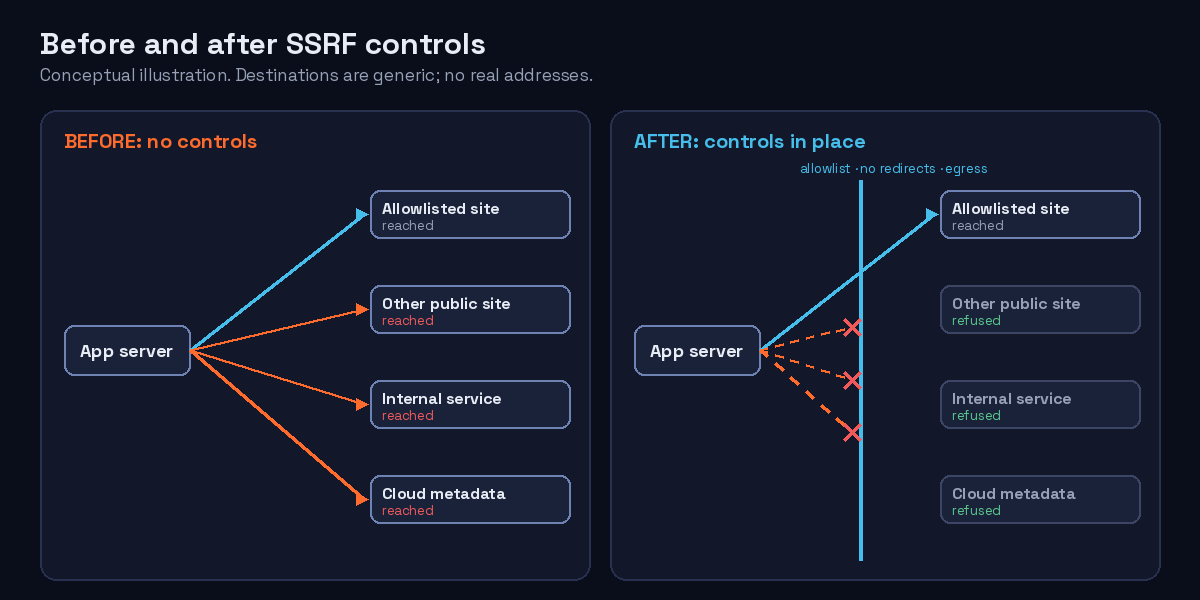
What stops it
Before and after controls. Conceptual illustration; destinations are generic.
Allowlist, don’t denylist. Match the host to an explicit list and build the request yourself.
Block link-local. If a denylist is unavoidable, block 169.254.169.254, loopback, private ranges and IPv6 equivalents.
Segmentation and deny-by-default egress: the fetching component sits in its own zone with one controlled way out.
Want this tested on your own app?
PoCForge runs authorised web application and attack-surface assessments. For SSRF, we find every feature that fetches on a user’s behalf, test them the way a real adversary would within an agreed scope, check that allowlists, redirects, egress and metadata protections hold up together, and report clear, prioritised fixes your developers can act on.