
What changed
On 17 November 2026 Oracle and the OpenJDK project released fixes for CVE-2026-114938, a heap-based buffer overflow (CWE-122) in the x86-64 HotSpot Base64 decoder. CISA issued an alert the same day and referred to the flaw as “Java4Shell”. The same issue is also called Java2Shell; both names refer to this CVE, not to a second vulnerability.
Oracle and OpenJDK rate it 8.1 (high) under CVSS 3.1, with the vector AV:N/AC:H/PR:N/UI:N/S:U/C:H/I:H/A:H: the attacker needs no credentials and no user interaction, but Oracle rates attack complexity as high. Calif, the organisation that reported the bug, scores it 9.2 (critical) under CVSS 4.0. NVD republishes Oracle’s 8.1 score as a secondary metric. When we checked on 19 November 2026 the NVD record was still marked “Undergoing Analysis” and had no separate NVD base score.
CISA says specially crafted Base64 input could crash the Java Virtual Machine (JVM) and allow unauthenticated remote code execution. The flaw is not listed in CISA’s Known Exploited Vulnerabilities (KEV) catalogue (catalogue version 2026.11.18). CISA’s SSVC enrichment on the NVD record rates exploitation as “none”, automatable as “no” and technical impact as “total”. The Canadian Centre for Cyber Security, which contributed to CISA’s alert, said on 17 November that it was not aware of active exploitation at that time.
Who is affected
A host is in scope only when all three of the following hold. If any one does not, this CVE cannot be triggered there.
- An affected Java runtime. The OpenJDK advisory’s risk matrix marks the 17, 21, 25 and 27 lines for this CVE, and not standard Java 8 or 11. Calif and several vendor write-ups say the vulnerable decoder first appeared in OpenJDK 17.0.6. Oracle’s November 2026 Critical Security Patch Update lists these supported builds as affected: Oracle Java SE 8u511b33-perf, 17.0.21.0.3, 21.0.13.0.3, 25.0.5.0.3 and 27.0.1.0.3; Oracle GraalVM for JDK 17.0.21.0.3 and 21.0.13.0.3; and Oracle GraalVM Enterprise Edition 21.3.20.0.3. Oracle’s usual advice is that earlier builds in those affected release lines are also likely to be affected. The Java 8 entry is Oracle’s Enterprise Performance Pack, not standard Java 8.
- x86-64 hardware with AVX-512 VBMI. CERT-EU and Calif say the JVM must be running on a processor that exposes
avx512f,avx512bw,avx512vbmiandbmi2(in practice, Intel Xeon Ice Lake or later, or AMD Zen 4 or later). ARM64 systems are not affected. The same container image can therefore be exposed on one node and not on another, depending on the CPU it lands on. - A path that decodes untrusted Base64. Typical examples are HTTP Basic authentication, JSON Web Tokens, SAML messages, cookies, file uploads and other network messages. Oracle notes that exploitation is by supplying data to APIs in the affected component, such as through a web service, not through untrusted Java Web Start applications or applets.
Distributions built from OpenJDK are in scope until their vendor’s fixed build is installed. That includes Eclipse Temurin, Amazon Corretto, the Microsoft Build of OpenJDK, Azul Zulu, BellSoft Liberica, SAP SapMachine and Red Hat’s build of OpenJDK, each of which ships fixes on its own schedule. JFrog reports that Eclipse OpenJ9 is not affected. Products, appliances and container images that bundle their own Java runtime are easy to miss in a software inventory; CISA specifically warns that those runtimes may not appear as separate inventory entries.
Calif has reported working remote code execution, in default configurations, against Keycloak, Atlassian Jira, Atlassian Confluence, JFrog Artifactory, Jenkins and PingFederate without authentication, and against Apache Kafka, Apache Solr, Elasticsearch, Gerrit and Spinnaker with authentication. Those are researcher demonstrations on the products named, not a claim that every installation is exploitable, and they are not a complete list.
How it works (high level)
Java applications are memory-safe, but the HotSpot JVM is not: parts of it are written in C++ and assembly. To speed up java.util.Base64 decoding, HotSpot can replace the ordinary Java implementation with a CPU-specific intrinsic on x86-64 processors that support AVX-512 VBMI. Calif reports that when that intrinsic handles Base64 input with padding in the wrong place, it miscalculates how much output to write and writes past the end of its output buffer on the Java heap. The application may still reject the malformed input, but the write has already happened.
The immediate results can be a crash or corruption of neighbouring heap memory. Calif says the same corruption can be used to disclose memory and, in some applications, to reach code execution inside the Java process. Oracle’s high attack-complexity rating reflects that turning the overflow into reliable code execution is not straightforward and depends on the application, the runtime and the hardware. We do not publish exploit details, payloads or proof-of-concept material.
What to do now
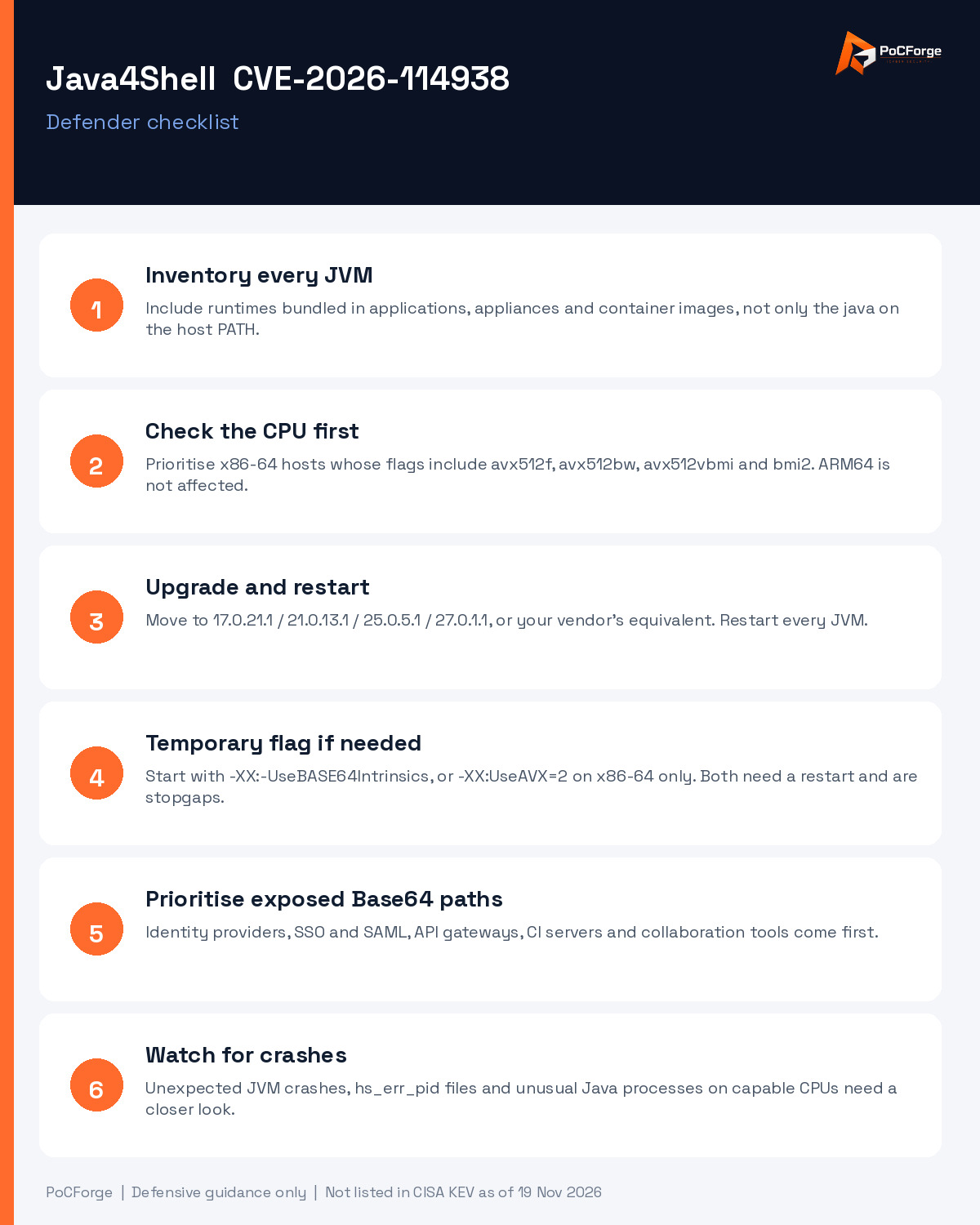
- Inventory every Java runtime, including those bundled inside applications, appliances and container images, not only the
javaon the host PATH. Record the vendor and the full version string. - Prioritise hosts that meet the hardware requirement. On Linux, check whether the processor flags include
avx512f,avx512bw,avx512vbmiandbmi2. Use this to order the work, not to close the finding: the same workload may later be scheduled onto a CPU that does have those features. - Upgrade to a fixed build and restart every JVM. Upstream fixed releases include 17.0.21.1, 21.0.13.1, 25.0.5.1 and 27.0.1.1, Oracle Java SE 8u513-perf, and Oracle GraalVM Enterprise Edition 21.3.20.1 (as listed by the Canadian Centre for Cyber Security). Use your distribution’s equivalent build. A JVM that is not restarted keeps running the old binary. Rebuild container images rather than assuming a host package update has changed the image.
- If you cannot patch yet, apply a temporary JVM flag and restart. Calif and JFrog document
-XX:-UseBASE64Intrinsics, which turns off the hardware-accelerated Base64 path. CERT-EU documents the same flag together with-XX:+UnlockDiagnosticVMOptions. The alternative is-XX:UseAVX=2, which disables AVX-512; apply that flag only on x86-64, because OpenJDK on ARM does not recognise it and will fail to start. Both options can reduce performance and are stopgaps, not fixes. - Prioritise internet-facing services that decode attacker-supplied Base64, such as identity providers, SSO and SAML endpoints, API gateways, CI servers and collaboration tools. Until a fix is in place, CISA also recommends restricting and validating Base64 at the application boundary, enforcing input-size limits, and limiting unauthenticated access.
- Track vendor advisories for products that bundle Java, and apply those updates when they appear. Unsupported interim Java lines (18–20, 22–24 and 26) do not receive this fix; move those workloads to a supported line.
How to check for compromise (high level)
- Look for unexpected JVM crashes,
hs_err_pidfiles, and heap-corruption errors on x86-64 hosts that support AVX-512, especially on internet-facing services that decode Base64. Failed attempts may look like crashes rather than a clean compromise. - Review CISA’s suggested indicators at a high level: rogue runtimes, unexpected JVM processes, and unusual Java process behaviour.
- Review application, web-server, authentication and endpoint logs around the disclosure date for unusual traffic to Base64-bearing endpoints (authentication headers, token or SAML endpoints, file-upload APIs).
- If an unpatched, internet-facing service on a capable CPU was exposed, treat it as possibly compromised even if you have not found a crash. Preserve logs, rebuild from a known-good runtime if in doubt, and rotate credentials the application could have held in memory.
Timeline
- 17 November 2026: Oracle publishes the November 2026 Critical Security Patch Update, and the OpenJDK Vulnerability Group publishes its 17 November advisory, fixing CVE-2026-114938. Calif publishes its Java4Shell write-up. CISA issues an alert urging immediate patching. The Canadian Centre for Cyber Security publishes alert AL26-029.
- 18 November 2026: CERT-EU publishes Security Advisory 2026-021. NVD lists the CVE as undergoing analysis and republishes Oracle’s score. CISA’s KEV catalogue version 2026.11.18 does not include this CVE.
- 19 November 2026: This note. The CVE was still absent from the KEV catalogue when we checked the official JSON feed (catalogue version 2026.11.18).
Methodology note
This note is based on the OpenJDK Vulnerability Advisory of 17 November 2026, Oracle’s November 2026 Critical Security Patch Update and its text-form risk matrix, CISA’s 17 November alert, the official KEV JSON feed (catalogue version 2026.11.18), the NVD record for CVE-2026-114938, CERT-EU advisory 2026-021, the Canadian Centre for Cyber Security alert AL26-029, Calif’s Java4Shell write-up, and secondary write-ups from JFrog, Microsoft and SecureLayer7, all checked on 19 November 2026. We have not reproduced the issue or tested Java runtimes for this article. We do not publish exploit details, payloads or proof-of-concept material. Personal names have been omitted; organisations are credited.
How PoCForge can help
We can help you find Java runtimes, including those bundled in products and containers, review which hosts meet the hardware and input-path conditions, and check internet-facing services for signs of misuse. We do not publish exploit details.
Sources
- OpenJDK Vulnerability Advisory: 2026/11/17
- Oracle Critical Security Patch Update Advisory — November 2026
- Oracle: text form of the November 2026 risk matrices (Oracle Java SE, CVE-2026-114938)
- CISA: Critical Java Vulnerability Requires Immediate Patching (17 November 2026)
- CISA Known Exploited Vulnerabilities catalogue (checked 19 November 2026; CVE-2026-114938 not listed in catalogue version 2026.11.18)
- NVD: CVE-2026-114938
- CERT-EU Security Advisory 2026-021: High Severity Vulnerability in Java SE and OpenJDK
- Canadian Centre for Cyber Security: AL26-029 — Critical vulnerability impacting Oracle Java (17 November 2026)
- Calif: Java4Shell
- JFrog Security Research: Java4Shell (CVE-2026-114938)
- Microsoft for Java Developers: Java OpenJDK November 2026 Critical Patch Update
- SecureLayer7: What is Java2Shell? (secondary source for the Java2Shell name)
- MITRE: CWE-122 Heap-based Buffer Overflow