
What changed
On 18 November 2026 F5 and the nginx project released fixes for five memory-corruption vulnerabilities in NGINX Open Source and NGINX Plus. Researchers at Xint call the set NGINX2Root and published a disclosure site at nginx2root.com. F5 and nginx.org do not use that name. The lead issue, CVE-2026-123007, is memory corruption in HTTP/2 flow control. nginx.org rates it major and lists every official Open Source release from 1.9.5 through 1.31.8 as vulnerable — HTTP/2 support has been in the code since 2015.
F5 rates each of the five CVSS 3.1 8.1 (high), vector AV:N/AC:H/PR:N/UI:N/S:U/C:H/I:H/A:H, and CVSS 4.0 9.2 (critical). An unauthenticated attacker can crash a worker process, corrupt its memory and, under some conditions, run code with the privileges of that worker. F5’s CVE description for CVE-2026-123007 says code execution typically depends on Address Space Layout Randomisation (ASLR) being disabled or bypassed. When we checked on 19 November 2026, NVD listed CVE-2026-123007 as “Received”, republished F5’s scores as secondary metrics, and had not published a separate NVD base score. The NVD record assigns CWE-191 (integer underflow) and CWE-787 (out-of-bounds write).
Xint also described a separate, still-unpatched use-after-free in the Linux kernel’s SCTP subsystem that can be chained with worker-level access to reach root on the host, including from a Docker container in their tests. That kernel issue had no CVE and no patch when we checked on 19 November 2026; Xint is withholding most of the technical detail until a kernel fix is available. The “to root” part of the name therefore depends on a second, independent flaw, not on the nginx bugs alone.
None of the five nginx CVEs is listed in CISA’s Known Exploited Vulnerabilities (KEV) catalogue (catalogue version 2026.11.18). CISA’s SSVC enrichment on the NVD record for CVE-2026-123007 rates exploitation as “none”, automatable as “no” and technical impact as “total”. CERT-EU said on 18 November that researchers had demonstrated CVE-2026-123007, and that no exploitation in the wild had been reported.
Who is affected
Each of the five flaws is an independent path. A server is only in scope for a given CVE when the relevant feature is in use. The Open Source version ranges below are from nginx.org; a bug present in the code is not automatically exploitable.
- CVE-2026-123007 — HTTP/2 flow-control memory corruption. Vulnerable: 1.9.5 through 1.31.8. The only precondition Xint and CERT-EU describe is HTTP/2 enabled on a listening port.
- CVE-2026-123633 — use-after-free in HTTP/2. Vulnerable: 1.19.7 through 1.31.8. HTTP/2 is enabled and requests are forwarded to an upstream server.
- CVE-2026-121810 — use-after-free in HTTP/3. Vulnerable: 1.25.0 through 1.31.8. HTTP/3 (QUIC) is enabled and requests are forwarded to an upstream server. (nginx.org’s advisory page currently renders the identifier as “CVE-CVE-2026-121810”; the CVE ID is CVE-2026-121810.)
- CVE-2026-123634 — use-after-free in the resolver during response processing. nginx.org lists 0.6.18 through 1.31.8 as vulnerable. CERT-EU and Xint describe a more specific tested configuration: a
resolveris set, aproxy_passdestination is built from request data, and amirror(or another subrequest such as SSI) resolves the same name. Xint notes that turning offmirroralone does not make a server safe if another subrequest path remains. - CVE-2026-113425 — use-after-free in the mail proxy module. nginx.org lists 0.5.33 through 1.31.8 as vulnerable. CERT-EU and Xint describe the tested setup as a mail proxy with
proxy onandauth_http.
Fixed Open Source releases are 1.30.7 (stable) and 1.31.9 (mainline). Those releases also include fixes for five further nginx CVEs that F5 shipped on the same day (CVE-2026-118899, CVE-2026-120993, CVE-2026-125283, CVE-2026-123640 and CVE-2026-120967). They are not part of the NGINX2Root set, but they are a reason to take the same update even if you have already applied the HTTP/2 workaround.
NGINX Plus is also affected. CERT-EU lists Plus 37.0.0 through 37.0.7.1, 37.1.0 through 37.2.0.1, and the R34, R35 and R36 branches. Tenable, summarising F5’s out-of-band release, reports fixed Plus builds 37.0.8.1 and 37.3.0.1, and says the R33 through R36 branches have no patch and must move to a 37.x release. We were not able to read F5 article K000163926 without a login, so Plus customers should confirm the exact affected and fixed builds in that vendor advisory.
Linux distributions may backport the fixes without changing the version string that nginx -v prints, so check your distribution’s own security advisory. Products that embed nginx, including OpenResty and Kubernetes ingress controllers, need their own vendor updates. Inventory those alongside standalone nginx.
How it works (high level)
CVE-2026-123007 is the most widely applicable of the five because it needs only HTTP/2 on a listener. CERT-EU describes it as an integer overflow in HTTP/2 flow control that causes an out-of-bounds write on the heap. F5 says processing undisclosed traffic can make the flow-control window exceed its allowed threshold, typically followed by a worker segmentation fault, with code execution possible if ASLR is absent or bypassed. The other four issues are use-after-free bugs in HTTP/2 connection draining, HTTP/3 stream handling, the DNS resolver waiting list, and mail-proxy authentication lookup. Each can, according to Xint and CERT-EU, lead to unauthenticated code execution in the worker process when the matching configuration is present.
The worker often runs as an unprivileged user. Reaching root on the host, or escaping a container, is a separate step. Xint’s demonstrations chained worker access with the unpatched SCTP kernel flaw; that kernel issue remains unpatched and has no CVE yet. We do not publish exploit details, payloads or proof-of-concept material.
What to do now
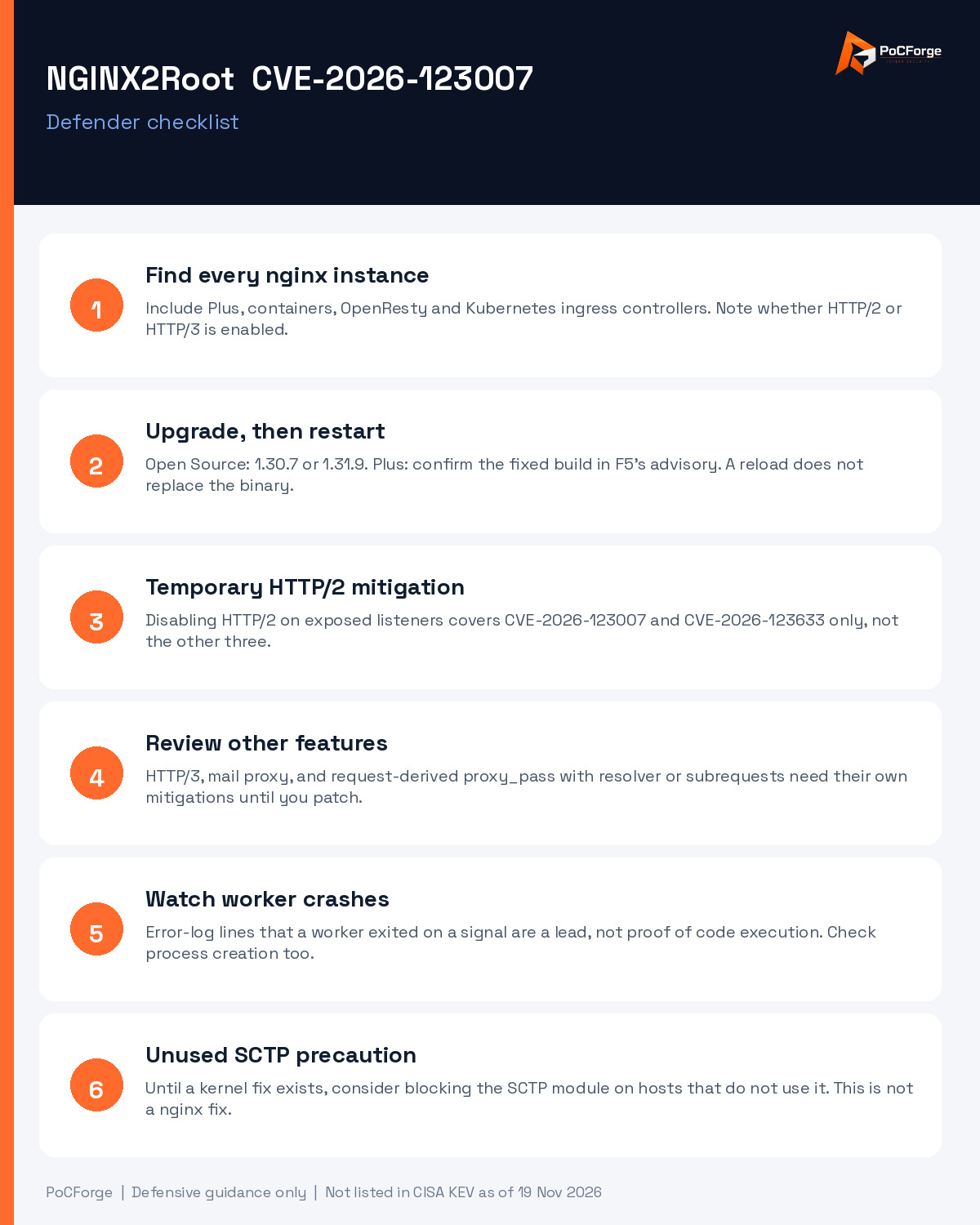
- Find every nginx instance, including NGINX Plus, containers, appliances, OpenResty, and Kubernetes ingress controllers. Record the version, whether the binary was built with HTTP/2 or HTTP/3, and whether those protocols are enabled on internet-facing listeners. Prioritise systems where nginx itself accepts client HTTP/2 or HTTP/3.
- Upgrade and then restart nginx. Open Source: 1.30.7 (stable) or 1.31.9 (mainline), or your distribution’s backported package. Plus: the fixed build confirmed in F5’s advisory (Tenable reports 37.0.8.1 and 37.3.0.1). Xint is clear that a configuration reload is not enough: a reload leaves existing workers running the old executable (they appear as “worker process is shutting down”). A restart replaces the binary. Expect a short interruption to connections that are already open.
- If you cannot patch yet, apply temporary mitigations that match the features you use. Disabling HTTP/2 on exposed listeners (remove
http2fromlistendirectives, or sethttp2 off;) addresses CVE-2026-123007 and CVE-2026-123633 only. Removing HTTP/3/QUIC listeners addresses CVE-2026-121810. Restricting access to the mail proxy addresses CVE-2026-113425. For CVE-2026-123634, avoid request-derivedproxy_passnames resolved at request time, and do not assume that turning offmirroris sufficient. None of these is a substitute for the update. - After a reload used only as a temporary mitigation, restart if old workers remain, so that already-open HTTP/2 or mail sessions are not left on the previous configuration.
- Until a kernel fix is available, Xint recommends blocking the SCTP module on hosts that do not use it. That is a precaution against the separate local privilege-escalation issue, not a fix for the nginx flaws.
- Confirm embedded products and ingress controllers with their vendors, and do not assume that updating the host nginx package has updated a bundled binary inside a container image.
How to check for compromise (high level)
- Watch the error log for worker processes that exit on a signal (CERT-EU notes this wording). That is a possible sign of a crash or an exploitation attempt, not on its own proof of successful code execution. Follow it with process-creation and host-forensic checks.
- Review process-creation logs for unexpected commands or shells started by the nginx worker account.
- If an internet-facing server accepted HTTP/2 (or another in-scope feature) and was unpatched after 18 November 2026, treat it as possibly compromised even if you have not found a crash. Preserve logs, rebuild from a known-good binary if in doubt, and rotate credentials the worker could have reached.
Timeline
Dates below for discovery and coordinated disclosure are from Xint and are given by that write-up in UTC.
- 11 October 2026: Xint discovers the vulnerabilities.
- 16 October 2026: Xint reports them to F5 through HackerOne.
- 20 October 2026: HackerOne completes validation.
- 27 October 2026: The reports are delivered to F5’s nginx development team.
- 9 November 2026: The nginx team requests patch validation.
- 10 November 2026: Xint completes patch validation. Xint says the vulnerable CVE-2026-123007 code was still present in the project’s main branch on this date.
- 18 November 2026: F5 and nginx.org publish the fixes (Open Source 1.30.7 and 1.31.9). Xint publishes the NGINX2Root write-up and nginx2root.com. CERT-EU publishes Security Advisory 2026-022. The five CVEs are not added to CISA’s KEV catalogue in version 2026.11.18.
- 19 November 2026: This note. The five CVEs were still absent from the KEV catalogue when we checked the official JSON feed (catalogue version 2026.11.18). The separate SCTP kernel issue still had no CVE and no patch.
Methodology note
This note is based on Xint’s NGINX2Root write-up and nginx2root.com, the nginx.org security advisories list, the NVD record for CVE-2026-123007, CISA’s official KEV JSON feed (catalogue version 2026.11.18), CERT-EU advisory 2026-022, and secondary write-ups from Sophos and Tenable, all checked on 19 November 2026. F5’s vendor article K000163926 is the NVD-listed advisory, but it required a login, so Plus version details are attributed to CERT-EU and Tenable and should be confirmed in that article. We have not reproduced the issues or tested nginx for this article. We do not publish exploit details, payloads or proof-of-concept material. Personal names have been omitted; organisations are credited.
How PoCForge can help
We can help you find internet-facing nginx and ingress deployments, review which listeners still offer HTTP/2 or HTTP/3, and check exposed systems for signs of misuse. We do not publish exploit details.
Sources
- NGINX2Root disclosure site (Xint)
- Xint: NGINX2Root — New Remote Code Execution Vulnerabilities in nginx Require Urgent Patching (18 November 2026)
- nginx.org security advisories (CVE-2026-123007, CVE-2026-123633, CVE-2026-121810, CVE-2026-123634, CVE-2026-113425)
- F5 security advisory K000163926 (listed by NVD; login required)
- NVD: CVE-2026-123007
- CISA Known Exploited Vulnerabilities catalogue (checked 19 November 2026; the five NGINX2Root CVEs not listed in catalogue version 2026.11.18)
- CERT-EU Security Advisory 2026-022: Critical vulnerabilities in Nginx
- Sophos: Advisory — NGINX Vulnerabilities, nginx2root (18 November 2026)
- Tenable: NGINX2Root FAQ (18 November 2026)